Ahmad, N., Toyama, N., Szücs, F. L., Georgiadou, A. & van der Walle, H. A. (2026). 19th International Conference of Students of Systematic Musicology (SysMus26). Zenodo. 19th International Conference of Students of Systematic Musicology (SysMus26), Durham University, United Kingdom. https://doi.org/10.5281/zenodo.21416409
10 July 2026: Presentation material submission deadline >>> see Submission guidelines here
22-24 July 2026: SysMus26 in Durham!
What is SysMus?
SysMus conferences are annual, international, student-run events. They are designed to bring together advanced students and early-career researchers and provide a platform to present, meet with, and discuss our work with our peers.
Specifically, SysMus is committed to representing an array of topics from various sub-fields of systematic musicology and music science — a non-exhaustive list includes: music perception, music cognition, music psychology, music sociology, music therapy, music information retrieval, music technology, musical acoustics, music modelling, music education, music and culture, music and semiotics, music philosophy, music theory and analysis, and music composition.
In line with this, we encourage submissions from quantitative, qualitative, and practice-based methods and outputs.
Submission Guidelines
Proposals should include a title, author(s), affiliation(s), abstract (300 words), and 3–5 keywords.
Abstracts should be no longer than 300 words excluding references. Authors should avoid identifying themselves within the abstracts (self-citation allowed), as acceptance will be determined by anonymous peer review.
Please include the following headings in your abstract, observing the format appropriate for your research:
For theoretical/practice research/reviews: 1. Background 2. Aims 3. Main Contribution 4. Implications
You are required to indicate a preference for the presentation mode (long-form and/or short-form, details below) in the submission form. Abstract guidelines are the same for both presentation modes.
<<< submissions are closed & acceptance notifications sent>>>
After the reviewing process, authors will be given the opportunity to revise their abstracts based on the feedback received.
Presentation modes:
Long-form: Talks
→ 12-minute presentation time, 5-minute discussion.
Talks, live and virtual, are allocated a total of 20-minutes each: a maximum of 12-minutes for the presentation, 5-minutes for questions and discussion, and 3-minutes switch-over time for the next talk.
Short-form: Lightning Talks
→ 2-minute presentation time, 15-minute joint discussion.
This year, instead of poster presentations, we are holding Lightning Talk sessions; a collection of five video presentations with a joint roundtable discussion for the presenters.
Presenters will be grouped by topic (by our team), and their videos compiled to be played one after another. Then, all session presenters—virtual and in-person—will collectively answer (and ask!) discussion questions.
Lightning Talk sessions are allocated a total of 30-minutes each: a maximum of 2-minutes for each video presentation (10-minutes combined duration), 15-minutes for questions and discussion, and 5-minutes switch-over time for the next event.
Submitting presentation materials
TLDR & guidelines
TLDR: > must be uploaded & shared via Google Drive; > video format MP4; > file name convention SESSION_Surname_[first-3-title-words] (see preliminary schedule, not final) > email Google Drive file link to sysmus26@durham.ac.uk, subject “Material Submission: [Full name]”, full name included in email
Deadline = Friday 10th July, midnight BST
Types of submissions:
Lightning Talks: Both Online & In-person Presenters submit a 2-minute MP4 video presentation. The structure and content of the video are up to the presenter.
Long Talks: Online presenters submit a 10-12 minute video. In-person presenters submit a link to the Google Slides that they will present on the day of their talk.
Guidelines:
1. Upload your materials onto your ownGoogle Drive ← this ensures the storage sizes of your slides and videos don’t have to be limited by email sending / form submissions.
* If you did not make your slides in Google, please check through your upload to ensure the formatting is how you want/need it to look (text sizes/font/images often don’t transfer perfectly from PowerPoint, Keynote, or Canva, for example).
2. Name your uploads using this file naming convention: SESSION_Surname_[first-3-title-words] e.g., L11_Georgiadou_Designing-Accessible-Digital
3. In the Google Drive Share configuration of your file, ensure that General Access has “Anyone with the link” selected (“Viewer” recommended) ← this ensures any embedded materials (e.g. audio, video) play properly from our computer on the day.
4. Share your materials by clicking “Copy link” and pasting the links in an email to us at sysmus26@durham.ac.uk with the subject “Material Submission: Full name”, including your full name at the bottom of the email.
Upcoming news and information will be released by our organising team in due time — keep an eye out for updates!
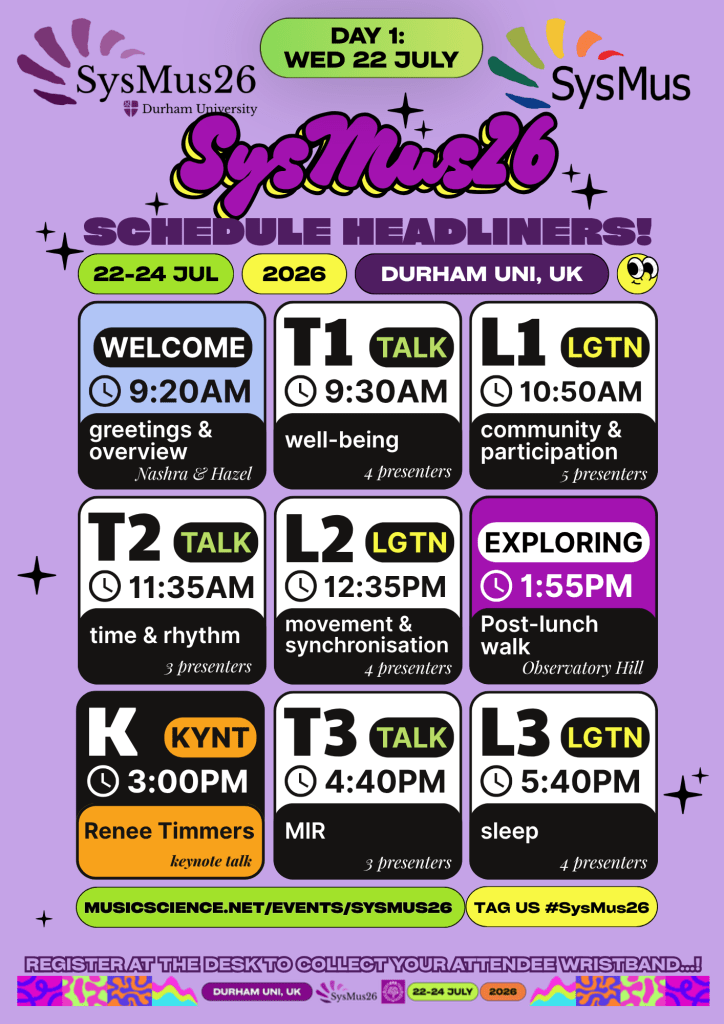
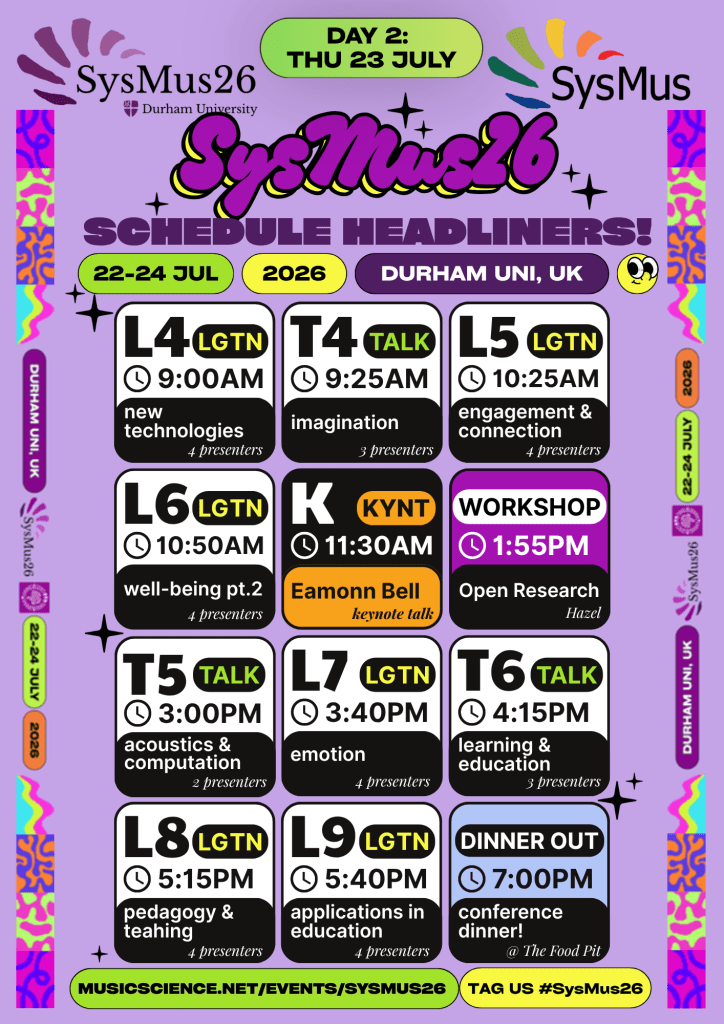
You can view a detailed schedule here: SysMus26-Schedule-read-only. There are three tab sheets, “overview”, “detailed layout”, and “presenter info”. Have a look through to see the fun things in store.
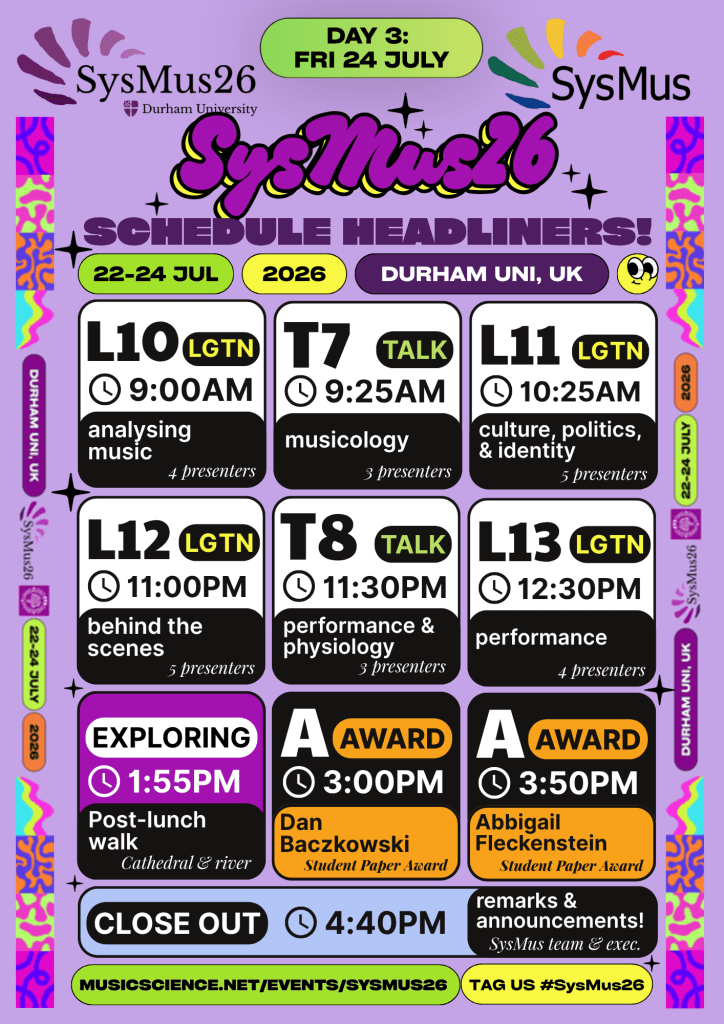
Below is a sneak-peek of the schedule posters! These will be up around the venue during the conference…
HEADLINERS 💫🔭
2 Student Award talks — Dan Baczkowski & Abbigail Fleckenstein 2 Keynote talks — Prof Renee Timmers & Assoc Prof Eamonn Bell Open Research workshop — Hazel Aileen van der Walle
Student Awards
SysMus is powered by the ideas and energy of early‑career researchers. To celebrate that spirit, we’re dedicating two extended keynote‑style slots to the Student Award winners — the authors of this year’s highest‑scoring abstracts. These talks give emerging scholars the stage to share bold work, spark discussion, and collectively explore where future research is heading.
Please join us in congratulating our Student Award winners:
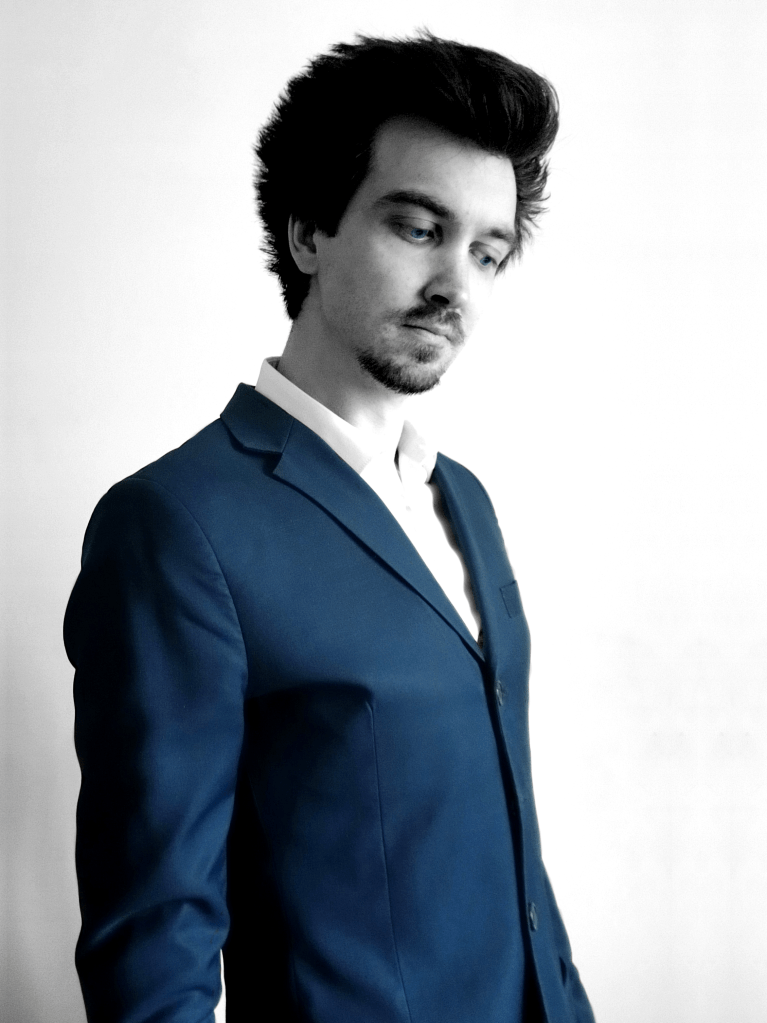
Dan Baczkowski:
“Embedding music research into live concert experiences: Effects of bespoke composition and listener-responsive visuals”
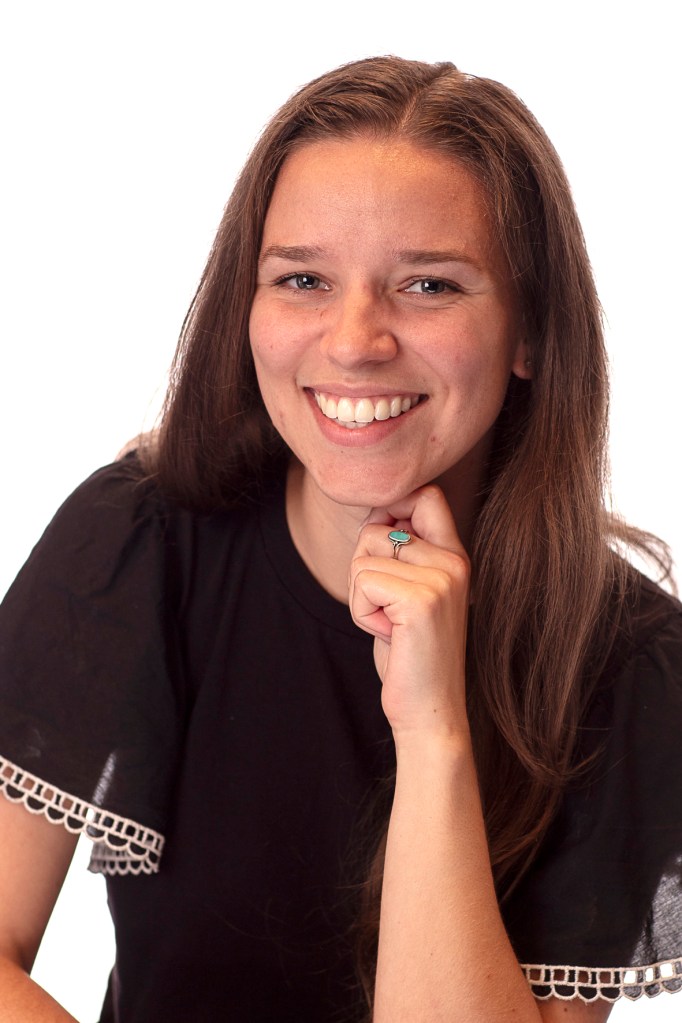
Abbigail Fleckenstein:
“Moral Echoes: Do Humanness and Morality Affect Emotional and Aesthetic Responses to Music?”
Keynotes
Reflecting SysMus’s commitment to showcasing the full breadth of systematic musicology — from psychology, sociology, and education to technology, philosophy, theory, and beyond — we are pleased to host two keynote speakers whose research highlights distinct strands of the field. Their sessions give us the chance to dive into different areas of music research, ask questions, and engage in these emerging directions together.
We are delighted to announce Renee Timmers and Eamonn Bell as our keynote speakers! Read more about them below:
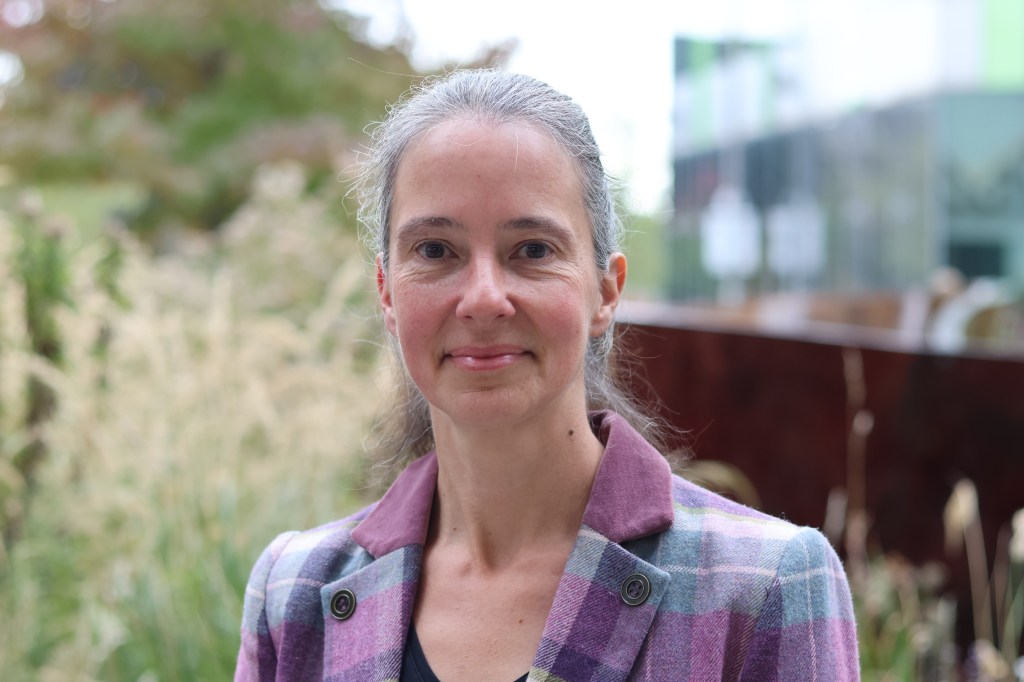
Renee Timmers
Bio:
Renee Timmers is Professor of Psychology of Music at the University of Sheffield, UK, where she directs the research centre Muses, Mind, Machine, and the MA in Psychology of Music. In over 100 publications, including 4 edited books, her research investigates multimodal and emotional experiences of music, expression and communication in music performance, and music for health and wellbeing. She promotes interdisciplinary collaboration and exchange as part of past and current roles in learned societies (ESCOM), research networks, and editorial appointments, and fosters collaborative research that enables innovation in music education and industry.
Talk Title:
Multimodality and embodiment of timing and tempo
Rhythm and movement are closely connected in the sense that movement generates rhythm, and rhythms often induce a sense of motion. Nevertheless, timing and tempo have been traditionally modelled as existing in the abstract with a reference to an internal clock and idealised tempo curve that slows down and speeds up as required for musical expression. In this presentation, I go back to some of the old debates on tempo curves, expressive timing and internal clock models, and I will consider current developments in embodied cognition and their considerations of tempo and timing. The discussions are illustrated using data and research findings. This is an opportunity to refine how we think about, predict and test the role of multimodality and movement for timing and tempo perception and production.
Eamonn Bell
Bio:
Eamonn Bell is Associate Professor in the Department of Computer Science at Durham University. His research interests fall under the broad umbrella of the digital humanities, with a focus on music and twentieth-century music technology. He has worked on: the application of mathematical and contemporary computational techniques to solve problems in musicology, music theory, and the humanities; the history of the computational sciences and digital technology, particularly as it relates to musical production and consumption in the twentieth century; identifying and lowering barriers to accessing digital research infrastructure (DRI) supporting computationally intensive research by non-specialists.
(Systematic) Musicology and Computing: A Match Made in Heaven or a Marriage of Convenience?
Though systematic musicology long predates the age of computing, there appears to be a tight and ultimately symbiotic relationship between the two fields. In fact, instruction in programming and computational statistics are commonplaces in many music programs, while computer science departments now offer courses in music information retrieval. Like all interdisciplinary intellectual endeavours, however, this is not an inevitable consequence of the structural similarities between the research objects in the two domains. Rather, the influence of personality, politics, and the relative power of academic disciplines on the development of this relationship cannot be underestimated. In this talk, I describe my own experiences bridging the gap between music and computing and reflect on the challenges and opportunities particular to interdisciplinary research in this area. I also draw on less well-known examples of this kind of research from the second half of the twentieth century. Taking the autobiographical and the historical together in this way provides an opportunity for critical self-reflection and inspiration for the future of both disciplines in a rapidly changing world.
Open Research — from transparent methods and reproducible workflows to open materials, collaborative practices, and research accessibility — is an important part of research and is becoming increasingly more talked about. But in conversations centred on the “hard” sciences, how can we apply these practices within systematic musicology?
To create space for these conversations at SysMus26, we are hosting an extended Open Research session designed as an interactive workshop and discussion forum. Rather than a traditional lecture format, this session will encourage participants to share experiences, discuss challenges, explore practical tools and workflows, and collectively reflect on how open and reproducible practices can strengthen music research across disciplines.
The session will also spotlight the work of ReproducibiliTea, the grassroots journal club initiative supporting conversations around reproducibility and Open Research across the academic community. We are delighted to highlight their resources and community-building efforts as part of this year’s programme.
Whether you are already involved in Open Research practices or simply curious to learn more, we are excited and eager for all to join the discussion.
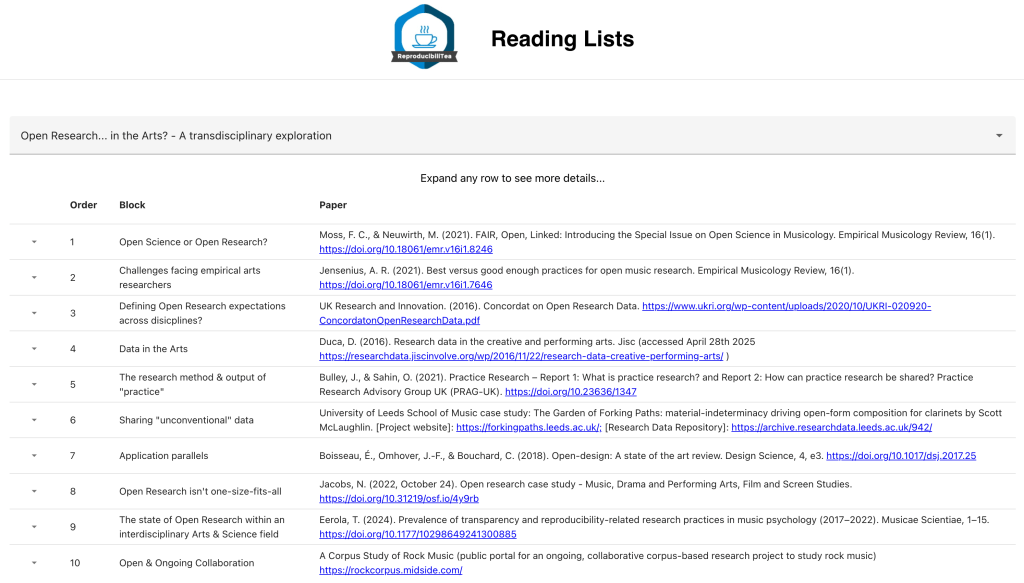
Fancy reading up and getting in the know beforehand? Check out this reading list curated by Hazel for “Open Research… in the Arts?” You can access this from the dropdown menu @ https://rpt-rl.netlify.app
[screenshot of ReproducibiliTea’s Reading Lists page, OR in the Arts page selected]
⭐️Trentaquattro: tiramisu! Regular non-alcoholic or matcha versions. They also do focaccia sandwiches and fresh juices/smoothies https://maps.app.goo.gl/WfABoy19reYYQ2Cd9
Mr Whippy: a classic, you know what you’re getting: soft-serve ice cream and other iced goods. Usually found in Durham’s Market Place somewhere… https://maps.app.goo.gl/WDaV5LwNswAEmxyX7
Market Hall: the bizarre bazaar of Durham, whether in search of old CDs, handmade jewellery and rugs, hardware supplies, queer books, or fresh fish https://maps.app.goo.gl/oqGrpLQ7s6feWoqJ6
CAFÉS:
Whitechurch: right across from the conference location, very popular with the students (probably to do with the close proximity to the library) https://maps.app.goo.gl/XaxzoBAZL2GyTQcq9
Flat White Café: hot drinks and baked goods https://maps.app.goo.gl/YrXJdCrkbXPmb8tS8 // Flat White Kitchen: bigger sister version of the café but with full meal items (breakfast/brunch/lunch)
⭐️Leonard’s Coffee House: great wee tucked away spot with yummy stotties (North East England traditional bread), toasties, and other assorted brunch and baked items https://maps.app.goo.gl/Rh1mcWHGHNvJvHCE9
Riverview Kitchen: cafe with lovely hot drinks, cakes, and brunch items. Right on the river (surprised?) with newly extended outdoor seating area https://maps.app.goo.gl/uS41xzCGQPkfBBxWA
Zaap Thai Street Food: a chain that is well worth the visit if you haven’t been before. Yummy Thai food and super lovely staff https://maps.app.goo.gl/B5enngwEUaNq836YA
⭐️Ye Old Elm Tree: quaint wee charming pub, worth the walk up the hill (of which there are many a steep one here, you’ll get used to them) https://maps.app.goo.gl/UeEjCyfLernFF3HP6
Wetherspoon, Bishops’ Mill: (you knew it was coming) a true institution of British culture, a “Spoons” as the Brits fondly call it. We will most likely have joint trips here when the days are over but had to be added https://maps.app.goo.gl/mYkM6x6m5dneU4iB7
Kindly sponsored by SEMPRE, ESCOM, and Durham University’s Faculty of Arts & Humanities