
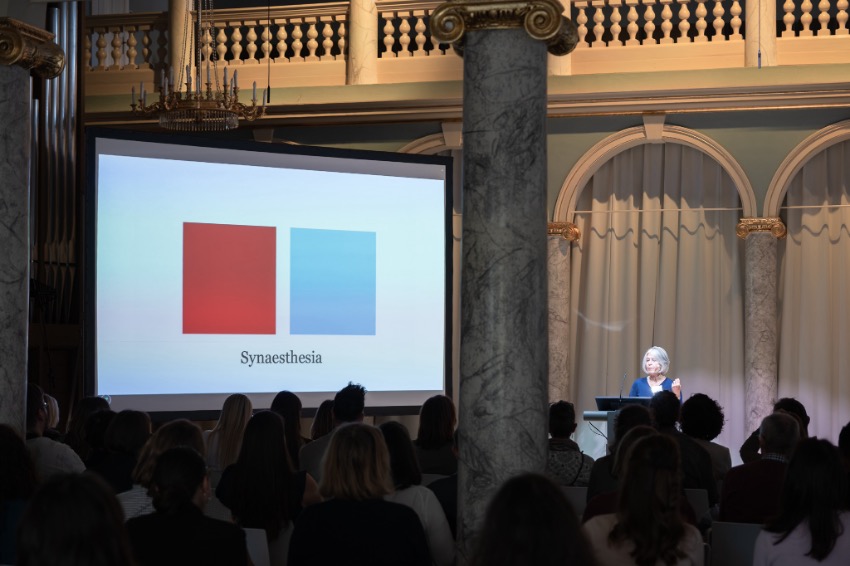
In April 2025, I received an unexpected email from Blanka Bogunović inviting me to deliver a keynote at the Psychology and Music – Interdisciplinary Encounters (PAM-IE) conference in Ljubljana, Slovenia, in October 2026.
As Treasurer of the European Society for the Cognitive Sciences of Music (ESCOM) and a Leverhulme Early Career Fellow in Durham University’s Department of Music, I was delighted to receive the invitation. It was an opportunity to represent ESCOM and Durham University, share my research on imagination and synaesthesia, and contribute to the wider music science community.
It would be my first keynote lecture. Exciting, certainly, but also a little daunting. How could I bring together several strands of my research into a coherent and engaging story?
Finding the story
My research has long been concerned with music-colour synaesthesia, where music can evoke experiences of colours, shapes and visual patterns. More recently, my work as a Leverhulme Early Career Fellow at Durham University has expanded to explore musical imagination, particularly how listeners construct narratives and perceive events as music unfolds.
The conference programme included music psychology, education, therapy, performance, cognition and wellbeing. I was particularly keen to reach those interested in embodiment and individual differences. The challenge was deciding what to include, what to leave out and how to pitch it to such a varied audience.
Eventually, I settled on a title: When Music Paints: Colour, Emotion, and Imaginative Listening.
Preparing for Ljubljana
From the outset, I knew I wanted to do something a little different. Not quite a TED Talk, but not a conventional academic lecture or conference presentation either. I wanted to take the audience on a journey through my research.
The organisers had given me 45 minutes, which seemed about right. In the end, my talk was a little shorter. I started preparing early, and it took far longer than I anticipated. I spent a lot of time refining the storyboard, working out how the different elements fitted together and deciding on the right level of detail.
The slides presented their own challenge. Academic presentations can so easily become crowded with statistics, tables and graphs. Of course, the evidence matters, but I wanted slides that were interesting to look at without being cluttered. They needed to give me room to talk. Above all, I didn’t want anyone falling asleep!
Eventually, after numerous revisions, I reached a version I was happy with. But there was one final test: my family.
I persuaded them to sit through a complete practice run. My audience consisted of a computer scientist, a psychology graduate and a business owner. Not quite the usual academic conference audience, but a rather useful one. None had spent months immersed in the material as I had.
My reasoning was simple: if they could follow the ideas and, most importantly, find them interesting, then I was probably on the right track.
Arriving in Ljubljana
After all those months of preparation, suddenly I was in Slovenia. I arrived a little tired from travelling, but excited and ready to go. I settled into my lovely room, had a shower and changed into something I felt comfortable wearing.
Ljubljana is a beautiful city. The Ljubljanica River runs through the centre, past bridges, cafés and colourful buildings, with the castle overlooking the old town. I managed to take some lovely photographs while I was there.
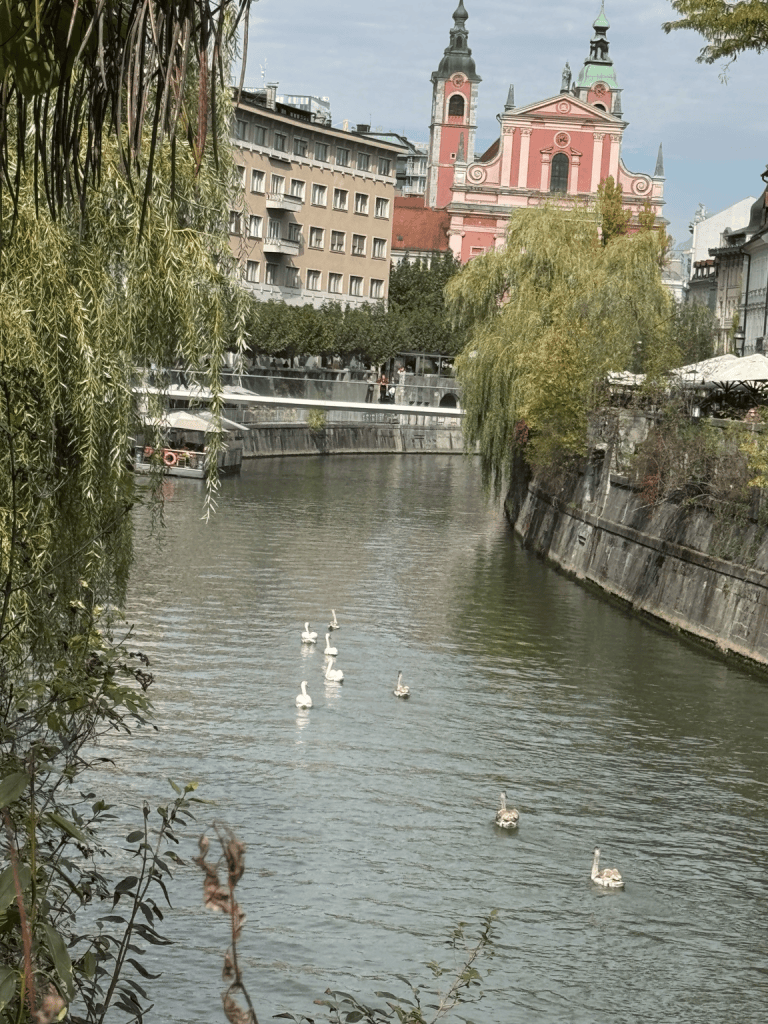
Ljubljana’s riverside, with swans on the Ljubljanica and the pink Franciscan Church. Photograph: Caroline Curwen.
The organisers couldn’t have been more welcoming. Katarina in particular was absolutely lovely and made me feel really special. By the time the keynote began, I felt very well looked after.
The keynote (and an unexpected triangle!)
The keynote took place in a magnificent hall at the University of Ljubljana’s Academy of Music, with chandeliers, marble columns and an extraordinary decorative ceiling. Quite a setting for my first keynote!
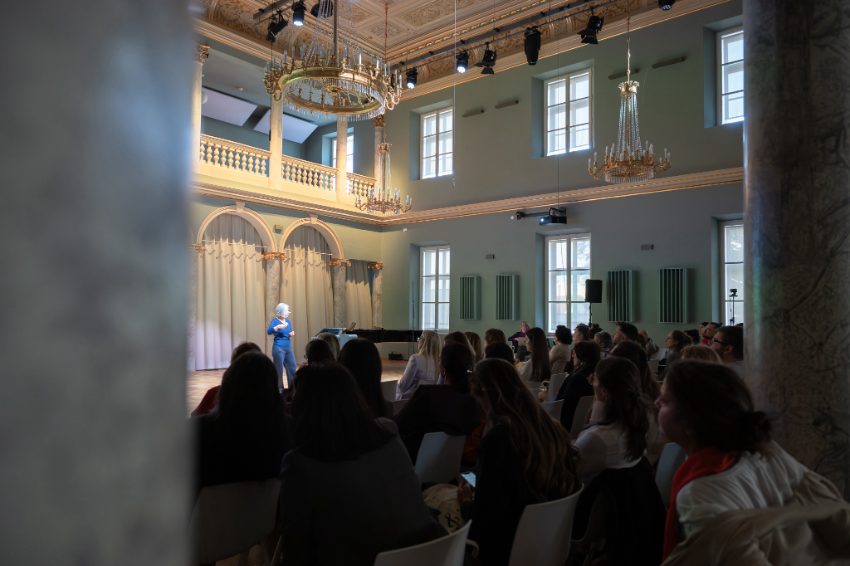
Delivering When Music Paints in the Academy of Music’s beautiful hall. Photograph: © Anika Možina.
Once I started speaking, I settled into the presentation and really enjoyed telling it. Everything seemed to be flowing nicely. There was, however, one slightly unexpected moment.
Beforehand, there had been some discussion about sounding a small triangle when my time was nearly up, but I was eventually told it wouldn’t be necessary. So, when I heard a sudden ding towards the end, followed by the sound of something being dropped, I wasn’t entirely sure whether I was supposed to stop!
I played it safe and hurried through my final slide. Looking back, I suspect I could simply have carried on. A small lesson for next time, perhaps! Thankfully, it didn’t spoil the experience.
Exploring music-colour synaesthesia during the keynote. Photograph: © Anika Možina.
The conversations afterwards
After the keynote, there were lots of questions from the audience. I also had a 30-minute session called “Coffee with Caroline”, where delegates could come along for a more informal discussion.
I had spent so long wondering whether I had pitched the talk at the right level. As it turned out, there was plenty to talk about!
One discussion about musical expertise stayed with me. A delegate who had taught in South Africa described skilled musicians with little formal training. It made me wonder whether my Western-centred materials and measures could overlook abilities developed in other musical traditions.
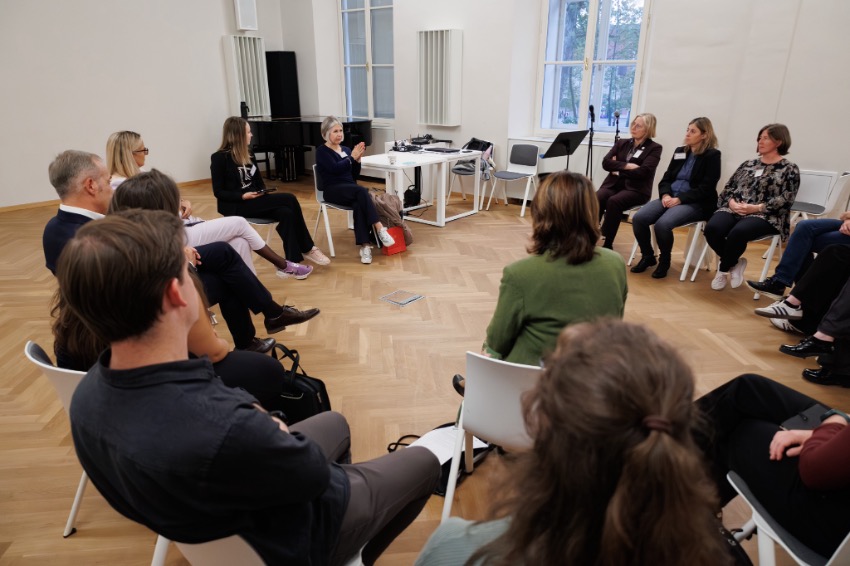
“Coffee with Caroline”: continuing the discussion with delegates after the keynote. Photograph: © Otton Zajec.
A memorable experience
I was absolutely delighted to have delivered my first keynote. I thoroughly enjoyed the whole experience.
I am particularly grateful to Katarina and the organising team for their kindness and generosity throughout my visit. They really did make me feel special!
When I first received Blanka’s email eighteen months ago, I had little idea how much work would go into preparing the keynote. The process taught me a great deal about communicating research, particularly the importance of deciding what to leave out.
But perhaps the most satisfying part was discovering that the approach had worked. After months of preparation, a rehearsal with my family and all those decisions about how to engage the audience, people were asking questions and wanting to continue the conversation.
And, perhaps best of all, I think I can safely say that nobody fell asleep!
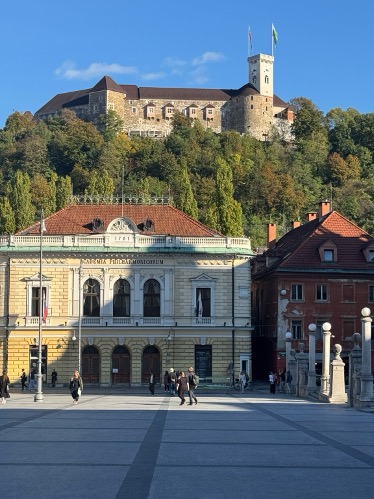
Ljubljana Castle overlooking the Slovenian Philharmonic. Photograph: Caroline Curwen.


Leave a Reply